
Neck wrinkles: why they appear and what you can do
By Emanuela Silvi, founder of Eligenda Roma.

Neck wrinkles can appear even when your face shows few signs of ageing. Age, individual characteristics, movement and sun exposure all contribute to the appearance of this area.
Extending your routine beyond the jawline is a practical step. Here we explain how, distinguishing what cosmetics can improve from changes that need a different kind of assessment.
At a glance
- The characteristics of neck skin vary between people and areas: there is no single skin thickness that applies to everyone.
- An exposed neck and décolletage need sun protection just as other exposed areas do.
- Horizontal lines, sagging and vertical bands are different signs.
- Apply products gently and as directed, without expecting the movement itself to provide a lifting effect.
- Moisturising may make some surface lines less noticeable; it does not reposition tissue.
- Eligenda’s leaflets specify neck use for the Cleansing Milk, Toner, Serum and Cream; the Serum and Cream directions also include the décolletage.
In this guide
1. The structure of neck skin
Skin thickness is not the same across every part of the face and neck. An ultrasound study of 118 adults found differences associated with sex, age and individual characteristics. Simply saying ‘neck skin is thinner’ does not describe the full variation.
With age, the structure of the dermis and its elastic properties change; sun exposure can contribute. Renewal of the skin’s surface is a separate process from the support provided by deeper tissues.
When planning your routine, consider whether the area is dry, irritated or inadequately protected from the sun. Its appearance alone cannot tell you which skin layer has changed.
2. Sebum, dryness and comfort
Your neck may feel drier than your face. Sebum is not the only factor: barrier lipids, the environment, cleansing and the products you apply also matter.
If your skin feels tight, a well-tolerated moisturiser can improve comfort and temporarily make some surface lines less visible. This is not the same as firming or lifting tissue.
Our guide to hyaluronic acid for the face explains this ingredient’s role in skin hydration.

3. The most common mistake: stopping skincare at the face
Many skincare routines stop at the jawline without us noticing. The face receives cleansers, antioxidants, serums and creams every day, while the neck is often overlooked or treated only occasionally.
An uncovered neck is exposed to light and the environment. Remember it when applying moisturiser and sunscreen, without assuming it needs all the same active ingredients as your face.
A simple check is to notice where you usually stop applying your products.
For this reason, your daily routine should give your face, neck and décolletage the same consistent attention.
Sun protection often stops at the jawline too
When your neck is uncovered, include it in your sun protection, along with your décolletage and the exposed back of your neck. Clothing, shade and sunscreen complement each other.
The link between UV exposure and collagen damage is documented. A 1997 study by Fisher and colleagues observed increased levels of enzymes that break down the skin’s matrix after experimental UV exposure on buttock skin. This research explored the mechanism of photoageing; it did not measure neck wrinkles or the effectiveness of an Eligenda cream.
To protect your skin from the sun, use a broad-spectrum sunscreen with SPF 30 or higher on exposed areas and reapply outdoors as directed, especially after swimming or sweating. Protection still matters when the sun feels less intense.
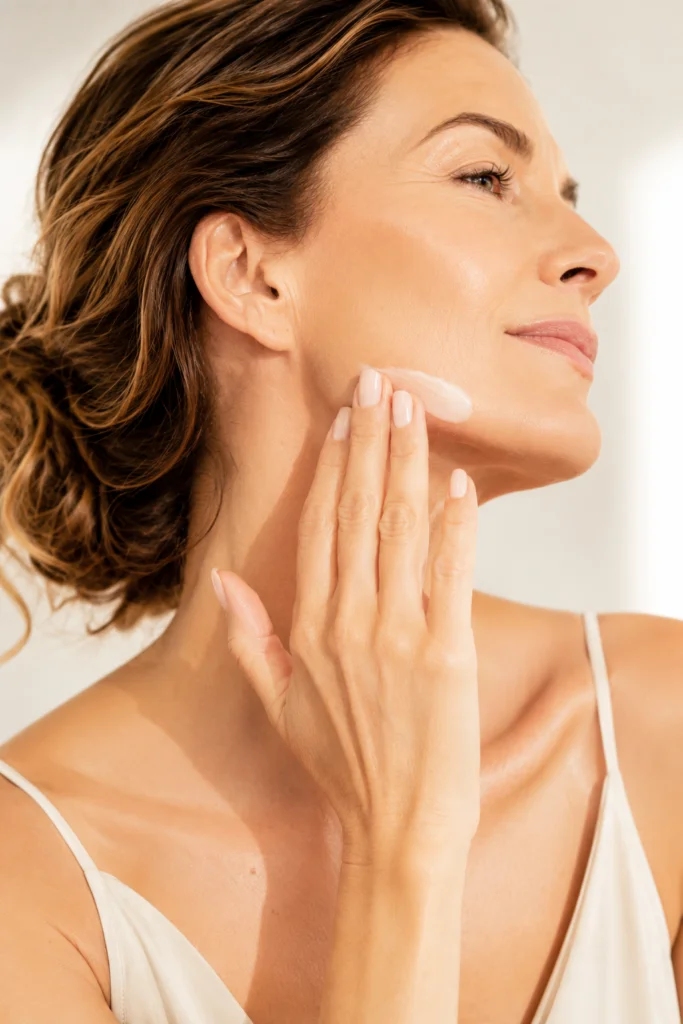
What to do each day: extend your face routine to your neck
Start with products you already tolerate, checking that their directions allow use on the neck. These are the same steps as a complete skincare routine, extended a little further down.
Beyond the face. Include your neck and décolletage. Apply moisturiser wherever it is needed; sunscreen should cover all exposed skin, including the back of the neck and upper décolletage.
In what order? Your neck can follow the same steps as your face if the products are suitable and well tolerated. Extend facial cleansing downwards, apply any toner to the areas specified, and use face serum and cream according to their directions. There is no need to repeat every facial active ingredient on an area that becomes irritated.
How should I apply it? You can spread the product from the collarbone towards the chin, without attributing a lifting effect to that direction. There is no need to press: apply it with a light touch.
How much? The area you are covering increases substantially, so an amount intended for the face alone will not be enough.
Do you really need a separate neck cream?
A dedicated neck cream is not always necessary. A face formula may also suit the neck if its directions allow it and your skin tolerates it. Hydration and comfort are useful criteria, alongside sun protection.
An anti-wrinkle face cream does not become a lifting treatment when applied further down: its effects remain those demonstrated for that particular formula.
Eligenda’s documents specify face and neck application for Restorative Cleansing Milk and Rejuvenating Facial Toner. The leaflets for Global Action Serum and Global Action Cream also mention the décolletage. There is no separate dedicated neck cream in the range: directions for use and evidence of a specific clinical effect are different things.
Horizontal neck lines, sagging and vertical bands
The term ‘neck wrinkles’ brings together three concerns with different origins. What a cosmetic product can do varies between them.
Horizontal lines across the neck. These folds, sometimes called Venus rings, can occur in younger people and become more visible over time. Posture alone does not explain them. A cosmetic product works on the condition of the surface: better-hydrated skin may show less pronounced texture in light falling across it. The fold itself remains. You can consider your habits without treating them as the certain cause of the crease.
Sagging and loss of firmness. Changes in the skin and underlying tissues contribute, softening the outline along the jaw and beneath the chin. This is often what people mean by an ageing neck, and what prompts a search for ways to firm neck skin. A well-tolerated product used consistently may affect hydration and how firm the skin feels. Repositioning tissue is beyond the scope of cosmetics.
Vertical bands. These can involve the platysma muscle and become more noticeable with its movements and with age. A cream cannot correct a muscular cause. We do not present neck exercises as a proven way to correct these bands. A pronounced change needs professional assessment to establish its nature.
This changes how you judge a result: it helps to know which of the three concerns you are addressing. The same principle applies to the eye area.
Firming neck skin: what skincare can do and how long it takes
Moisturising may temporarily make some surface lines less noticeable. Any improvement in other features depends on the formula and evidence for that product; it is not appropriate to promise the same result for every cream.
The American Academy of Dermatology explains the limits of firming creams: they do not lift tissue in the way a procedure can, and any changes may be modest.
The active-ingredient studies summarised in Eligenda’s catalogue use different protocols and durations. They are not studies of the finished products on the neck, so we do not use them to predict how many days it will take this area to change.
Posture, phones and pillows: habits that affect the neck
Keeping your screen at a comfortable height and taking breaks may reduce the time you spend with your neck deeply bent. These are comfort measures, not a proven treatment for removing horizontal neck lines.
Choose a pillow for comfort. If you have pain or sleep problems, follow the advice of the professional caring for you.
When it makes sense to see a doctor
When a change involves tissue position or a muscular component, it needs a doctor’s assessment. Medical tools and criteria differ from those used in cosmetic skincare.
Eligenda Roma Linea Nobile: skincare as your skin changes
Linea Nobile includes products for cleansing and moisturising. When caring for mature skin, choose according to comfort and the directions for use.
A biomimetic peptide complex is listed among the ingredients in Global Action Cream and Global Action Serum. Eligenda Roma’s catalogue summarises studies of the active ingredient; those data do not establish a percentage improvement in neck firmness or elasticity from the finished products.
The leaflets direct you to apply the serum and cream to your face, neck and décolletage. This confirms how to use them, without turning raw-material research into a promise to firm the neck.
Frequently asked questions
How can I get rid of neck wrinkles?
A cosmetic product cannot guarantee that wrinkles will disappear. Moisturising may make some surface lines less visible, but it does not reposition tissue or correct the muscular component of vertical bands.
How can I firm the skin on my neck?
A gentle routine and adequate sun protection support everyday care. The effects of creams are limited and depend on the formula; they are not equivalent to a lift, and results do not follow the same timeline for everyone.
How can I make my neck look younger without surgery?
Moisturising and protection from light are useful everyday steps. For pronounced changes in tissues or muscles, a doctor can discuss appropriate options. Posture changes and massage are not proven corrections for wrinkles.
How can I disguise neck wrinkles?
Moisturising may temporarily soften the appearance of some lines. If you use make-up, assess how it looks on your skin and apply it without allowing it to build up in creases.
What is the best cream for firming the neck?
There is no best cream for everyone. Choose a well-tolerated formula intended for that area. Eligenda’s Cleansing Milk and Toner leaflets specify the face and neck; the Serum and Cream leaflets also include the décolletage. This is not evidence of a lifting effect.
Why does neck skin become wrinkled?
Age, individual characteristics, sun exposure and changes in the skin and underlying tissues all contribute. Not every sign of neck ageing has the same origin.