
What is my skin type? At-home checks and AI facial analysis
By Emanuela Silvi, founder of Eligenda Roma.
Before choosing a face cream or serum, it can help to observe how your skin looks and feels. This guide compares at-home observation, online AI analysis and dermatological assessment, with practical guidance for your routine.
AI analysis is a guidance tool and does not replace a diagnosis or a dermatological consultation.
In this guide
What is facial skin analysis, and why is it the first step in skincare?
Observing your skin helps you describe its appearance: shiny areas, patches that feel tight, redness, uneven colour and visible lines. These clues can guide a routine, but do not measure water content, sebum levels or the condition of the skin barrier.
Choosing cosmetics also depends on sensations, habits and reactions to products. A photograph provides only part of this information; a dermatological assessment is needed when you want to understand the cause of a problem.
What is my skin type? The 5 skin types
Skincare often uses five practical descriptions. They are not fixed categories or diagnoses.
- Normal skin: does not feel particularly dry or show pronounced shine.
- Dry skin: may feel tight, look rough or flake. Dryness has different causes and can change over time.
- Oily skin: tends to look shiny and may also have visible pores and comedones.
- Combination skin: has areas with different needs, often with more shine on the forehead, nose and chin than on the cheeks.
- Sensitive skin: may respond with burning, stinging or discomfort to things that are usually tolerated. Sensitivity can coexist with dry, oily or combination skin.
The word dehydrated describes reduced surface hydration, which can occur alongside shine. Dryness and dehydration can overlap: a sensation or photograph is not enough to distinguish their causes with certainty. For help choosing a moisturiser, consult the American Academy of Dermatology’s guidance.
Skin type and phototype are not the same
Skin type is often confused with phototype, but they describe different things. Skin type concerns the balance of sebum and hydration: normal, dry, oily, combination or sensitive. Phototype describes how skin responds to the sun. The Fitzpatrick classification identifies six phototypes, from type I (very fair skin that burns and does not tan) to type VI (very dark skin).
Knowing both is useful: skin type guides your everyday routine, while phototype helps inform sun protection and dark-spot prevention. The Fondazione Umberto Veronesi offers a clear guide to skin phototypes to help you identify yours.
How to understand your skin type at home: 3 checks
These observations can help you describe how your skin behaves. They are not diagnostic tests, and there is no set waiting time that works for everyone.
- Observe your skin after cleansing. Use a gentle product and notice any tightness, burning or shine. Do not leave your skin without moisturiser for long if it feels uncomfortable: the cleanser itself can influence what you observe.
- Tissue or blotting paper. Press it gently against the skin without rubbing to see where it picks up oily residue. Creams, sunscreen and make-up can affect the result; the paper does not measure hydration or confirm a skin type.
- How your skin feels during the day. Note where it feels tight, becomes red or looks shiny, along with the products you have used. Repeating the observation on different days is more useful than a single check.
If discomfort persists, do not keep testing: a dermatologist can assess causes that simple at-home observation cannot distinguish.
Comparing the methods: at-home checks, apps/AI and a dermatologist
At-home observation, a report based on a photograph and a dermatological consultation serve different purposes. This table helps you choose according to what you want to understand about your skin.
| Method | What it offers | Limitations | Cost | When it is useful |
|---|---|---|---|---|
| At-home checks | Observations of shine, comfort and appearance | Non-diagnostic observation, influenced by products and current conditions | Free | An initial picture you can build yourself |
| AI analysis (photo) | A report on features visible in the photo | Does not measure water or sebum; photo quality and the algorithm affect the result | Free | An initial guide for your routine |
| Dermatological consultation | Medical history, skin examination and further investigations if needed | Clinical assessment; tools chosen according to the problem | Arrangements and cost depend on the provider | Specific concerns, diagnosis and skin conditions |
You can begin by observing your habits and how your skin feels each day. An online report adds a description of the photo, but is not a clinical assessment: if symptoms persist or skin lesions change, contact a doctor directly.
Facial skin analysis with artificial intelligence: how it works
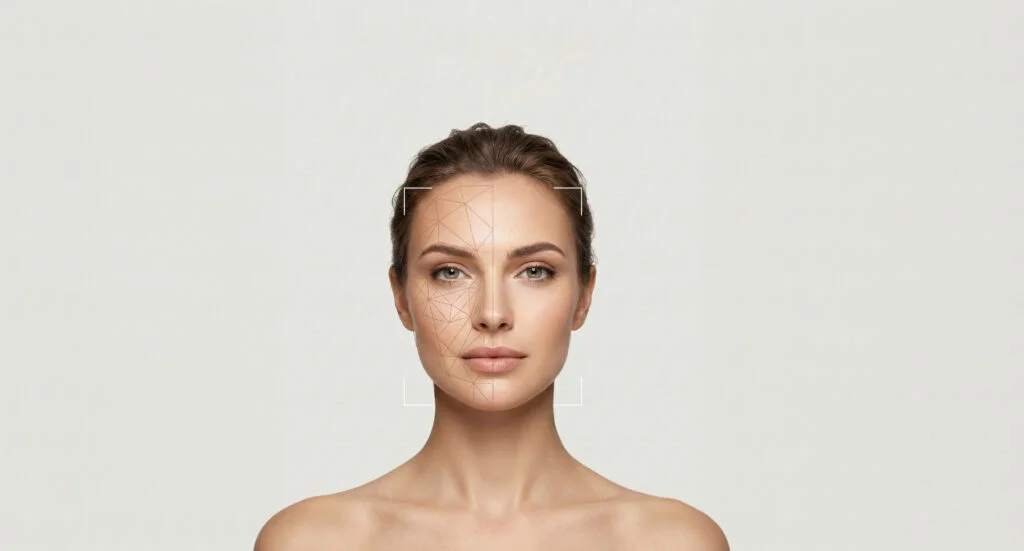
AI analysis processes a facial photograph and produces a report for cosmetic guidance. Its labels describe estimates based on the image: they are not skin measurements or a diagnosis.
- Skin type and apparent hydration: interpretations of visible signs, not measurements of sebum or water content.
- Radiance and evenness: descriptions also influenced by lighting, camera exposure and products on the skin.
- Dark spots and pores: visible features, without identification of their medical cause.
- Dark circles, puffiness and lines: features whose appearance changes with light, angle and expression.
The overall score is not an index of skin health or proof that a routine works. If you want to compare photographs, use similar conditions and no filters: the AAD explains how lighting and sharpness help document the skin. This photography advice does not validate our algorithm.
For persistent redness, itching, lesions or other skin problems, a dermatologist remains the appropriate professional.
Try your free skin analysis now
The online tool guides you through uploading a photo and requesting a report. Follow the instructions on the page, use a clear photo without filters and read the privacy notice before submitting it.
Use the result as a starting point for your routine, alongside how your skin feels. A product suggestion does not prove that the product is necessary or suitable for everyone.
Your routine according to your skin type
Once you understand your skin type, the next step is your routine. Here is a brief overview of the main aim for each skin type:
For the sequence of products, see our guide to skincare order.
| Skin type | Aim | Suggested texture | What to avoid |
|---|---|---|---|
| Normal | Maintain balance | Light and versatile | Too many active ingredients |
| Dry | Nourish and support the barrier | Rich and emollient | Harsh cleansers |
| Oily | Manage shine without irritation | Light and well tolerated | Overly rich formulas |
| Combination | Adjust amounts and textures for different areas | Adapted to the T-zone and cheeks | Repeated use of irritating products on the T-zone |
| Sensitive | Soothe and protect | Gentle and simple | Fragrance and strong active ingredients |
Eligenda Roma’s facial range includes products with different functions. Choose the steps that help your routine; you do not have to include them all:
- Cleansing: Restorative Cleansing Milk, applied and rinsed off according to the instructions.
- Toning: Rejuvenating Facial Toner, an optional step after cleansing.
- Serum: Global Action Serum, a cosmetic treatment to choose according to your needs and tolerance.
- Moisturising: Global Action Cream, the range’s facial moisturiser.
- Eye care: Delicate Eye Contour Cream, the product designed for the eye area.
You can explore the full facial skincare range. Treat the digital report as guidance and assess your routine by how your skin responds; persistent symptoms need a dermatologist’s advice.
The skin barrier and dehydrated skin: two things to pay attention to
The stratum corneum helps limit water loss and protect the skin’s surface. Dryness, tightness and burning may appear after harsh washing or other irritating exposure, but do not, on their own, identify a specific barrier problem.
If your skin is dry or reactive, simplifying your routine and choosing well-tolerated products may help. Dermatological advice for dry skin includes gentle cleansers and moisturising; persistent symptoms need assessment.
To understand a formula, see our guide to reading cosmetic INCI lists or use the online INCI analysis. The ingredient list alone cannot predict every effect of a product.
Skin analysis in Rome: online, wherever you are
Eligenda Roma is a skincare brand based in Rome. Our skin analysis in Rome is entirely online: you can use it from Rome or any other city, whenever you like, without travelling or booking an appointment.
If you have questions about the results or would like advice on a suitable routine, our team is available: email info@eligendaroma.com or call +39 06 92949434. We combine the convenience of digital analysis with the care of an Italian brand that formulates and knows its own products.
Frequently asked questions about skin analysis
How can I tell what skin type I have?
Observe shine, dryness and comfort at different times, taking account of the products you use. At-home checks and a photo report provide guidance: they do not measure water or sebum, or replace a clinical assessment.
How many skin types are there?
Skincare often uses the descriptions normal, dry, oily, combination and sensitive. These are practical guides: sensitivity and dehydration can accompany different skin conditions.
How does AI skin analysis work?
The software processes a photograph and produces a report on visible features. Scores are image-based estimates influenced by shooting conditions; they are not instrument measurements or diagnoses.
Is online skin analysis reliable?
It can offer cosmetic guidance, but cannot guarantee clinical accuracy or measure how well products work. Lighting, angle, make-up and the algorithm can affect the result.
How much does skin analysis cost?
Eligenda Roma’s online tool is offered free of charge. For a dermatological consultation, costs and arrangements depend on the provider and service chosen.
How often should I analyse my skin?
There is no clinically validated interval for this cosmetic report. If you repeat the photographs, keep the conditions similar; changes in the score do not, on their own, demonstrate a change in your skin.
Do I need to register for skin analysis?
Follow the instructions and read the privacy notice on the tool’s page before uploading a photo and requesting the report.
How can I tell whether my skin is dry or dehydrated?
Dryness and reduced surface hydration can overlap. Tightness, flaking or shine are not enough to distinguish the causes with certainty; if discomfort persists, seek a dermatological assessment.
How can I tell if I have combination skin?
This description is often used when the forehead, nose and chin are shinier than the cheeks. Observe your skin over time: a tissue or photograph does not provide diagnostic confirmation.
Does online skin analysis replace a dermatological consultation?
No. It is a tool for understanding your skin and guiding everyday care, not a diagnosis. For specific skin conditions, always consult your doctor or dermatologist.
What is the skin barrier, and how can I tell if it is damaged?
The skin barrier helps limit water loss and protect the skin. Dryness, redness and burning are signs to assess, but a photograph alone cannot establish their cause.
Final thoughts
Observing your skin is a good starting point for a simpler, more informed routine. Eligenda Roma’s photo report can help you organise those observations, while keeping its limitations clear. Understanding the cause of a problem or assessing a lesion requires a dermatological consultation.
Further reading
Find more information in our guides to skin concerns.