
What sets luxury skincare apart?
By Emanuela Silvi, founder of Eligenda Roma.
To assess premium skincare, start with the formula, label and information the brand provides. Here we examine ingredients, research, textures and production, with guidance on reading labels and evaluating product information.
In this guide
The characteristics of luxury skincare
Luxury in cosmetics encompasses the formula, sensory experience, packaging and service. To assess it thoughtfully, separate what makes the experience enjoyable from what demonstrates a benefit to the skin.
- Active ingredients and amounts. An ingredient’s presence is a starting point; its quantity, form and evidence relevant to the product all matter.
- Stability. A formula needs to retain its intended characteristics under the stated conditions of use and storage.
- Research. A test on a raw material is not the same as a study of the finished cosmetic. Look at what was measured and in whom.
- Raw materials and production. Traceability and checks are useful information when the brand documents them.
- Texture and sensory experience. Consistency, fragrance and packaging can make a product enjoyable to use, but do not measure its effectiveness.
These criteria help you assess the promises of products at any price. European rules on cosmetic claims require evidence appropriate to the statements made.

Beyond price: how to recognise quality skincare
Wording such as ‘dermatologically tested’ and the INCI list answer different questions. The former describes a type of testing stated by the brand; the INCI list names the ingredients.
Under Article 19 of the European Cosmetics Regulation, ingredients are listed in descending order of weight; those below 1% may appear in any order after ingredients present at higher concentrations. Position therefore does not reveal an exact percentage or establish that an ingredient near the end is useless.
Assessing a claim requires information about the formula and tests that match the stated benefit. We explain what INCI is and how to read an ingredient list. With the packaging to hand, you can also use the online INCI analysis to explore ingredient functions.
Luxury and mainstream skincare: what is the real difference?
‘Premium’ and ‘mainstream’ describe market positioning, not scientific categories of effectiveness. Both include formulas with different compositions, textures, packaging and prices.
Two products with an ingredient in common may behave differently because the amount, vehicle and other components vary. This does not mean you can assume the more expensive product will give a better result.
The American Academy of Dermatology notes that effective products are available at different prices. A useful choice brings together your needs, tolerance, available evidence and enjoyment of the product.
Fewer ingredients, more purpose
The length of an INCI list is not a quality ranking. Alongside active ingredients, a formula may need preservatives, emulsifiers and ingredients that maintain stability and texture.
A simpler composition can help someone who needs to avoid specific substances, but fewer ingredients do not guarantee fewer reactions. A natural extract or fragrance can also be a problem for someone who is sensitised.
The absence of silicones, parabens or petroleum-derived ingredients describes a formulation choice; it does not, on its own, demonstrate greater safety or gentleness.
Italian and artisan luxury skincare
Italian origins, carefully crafted packaging and a relationship with the producer can add tangible value to the buying experience. Check information about the supply chain, however, rather than inferring quality or freshness from the size of the laboratory alone.
A small batch does not, by itself, prove an active ingredient’s stability, just as Made in Italy does not measure clinical effectiveness. These are separate aspects to consider alongside the product documentation.
To guide your choice around your own needs, start with the guide to skin analysis, remembering that online analysis does not replace a dermatological assessment.
The ritual as part of luxury
Applying a product is part of the experience too. The feel of a texture and the time you set aside for your routine can turn an everyday step into a small personal ritual.
The texture beneath your fingers, the slow movements used to apply cream and the familiar gestures repeated each morning and evening can make a routine more enjoyable. A routine you enjoy is easier to maintain and can help you keep up habits suited to your skin.
Precision as a form of luxury: Eligenda Roma’s approach
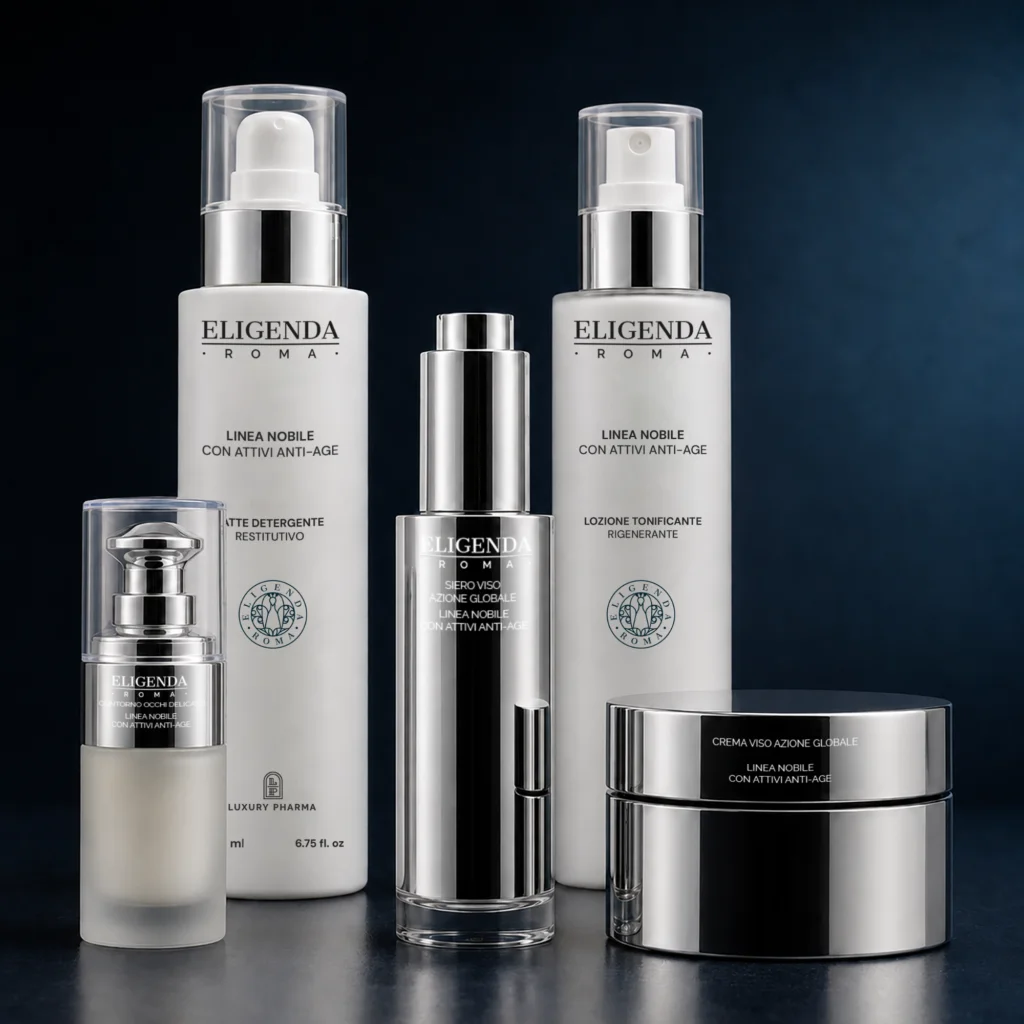
Eligenda Roma combines attention to formulation with care for texture, packaging and application. Its official documents describe Linea Nobile as free from silicones, parabens and petroleum-derived ingredients: a formulation choice, not a guarantee of universal tolerance.
The serum, cream and eye cream contain sodium hyaluronate in three molecular weights and biomimetic peptides. The Eligenda Roma catalogue presents data on certain active ingredients; these do not automatically demonstrate the same results in the finished products or justify promising a change after a fixed number of weeks.
The Eligenda Roma catalogue describes the cream’s spatula as silver plated and able to be converted into a pendant. This is a detail of design and craftsmanship, separate from cosmetic performance.
Ingredients and directions are provided in the official technical sheets and product leaflets.
If you want to know where to start, explore how to choose an anti-wrinkle face cream or a face serum for your needs, and read about what hyaluronic acid does for the face.
Frequently asked questions about luxury skincare
Do expensive creams really work better? Price does not demonstrate effectiveness. Compare the formula, intended use, tolerance and evidence for the claimed benefit; packaging and sensory qualities may have personal value separate from results on the skin.
How can you tell whether a face cream is good quality? Read the label and instructions, check that its promises are clear and look for tests relevant to the product. INCI helps identify ingredients, but does not always reveal their amounts or establish effectiveness on its own.
What does premium skincare mean? The term describes market positioning and can encompass the formula, sensory experience, service and packaging. It does not certify clinical superiority over products in other price ranges.
Is luxury skincare worth the money? That depends on your needs and the value you place on the formula, experience and packaging. A higher price does not guarantee better results.
Can natural skincare be luxurious? Yes, but an ingredient’s origin does not demonstrate effectiveness or safety. A formula containing plant extracts still needs to be assessed as a whole.
Why might artisan skincare be better? Craftsmanship can add value through workmanship and detail. Small batches and a short supply chain alone do not prove greater stability, freshness or effectiveness: verifiable information is needed.
Do more ingredients mean a better formula? No, and the reverse is not true either. A formula needs what is necessary for its intended use, including ingredients that help with preservation and stability. Tolerance remains individual.
How do I recognise premium skincare? You can assess its consistency, transparency, texture, packaging and documentation. For skin performance, look for relevant evidence rather than inferring effectiveness from price or an ingredient’s position in the INCI list alone.
At a glance
Luxury skincare can offer a carefully considered experience, from texture to packaging. Assessing its skin benefits requires the same criteria as any cosmetic: a suitable formula, tolerability, clear instructions and evidence that matches its promises. INCI is useful for identifying ingredients; on its own, it cannot measure quality or predict results.
Further reading
Find more information in our guides to cosmetic ingredients.