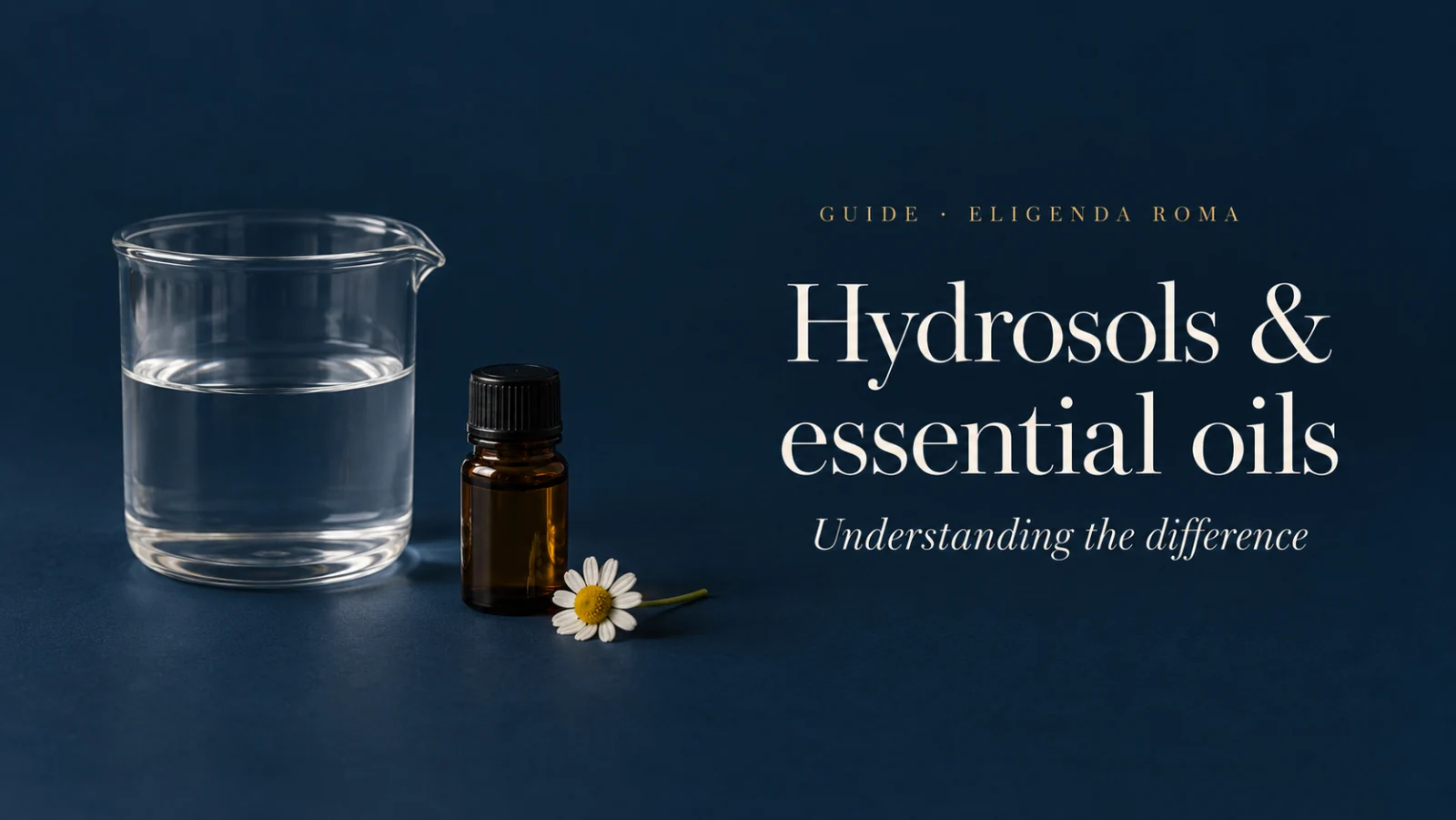
A hydrosol is an aromatic water collected during distillation; an essential oil is the concentrated aromatic oil. They can come from the same plant and still have different compositions and uses. A chamomile facial toner and a bottle of chamomile essential oil belong to different places in your bathroom.
The practical questions are straightforward: what is in the bottle, is it ready to apply, and how should you use and store it? Start there, rather than assuming the botanical name tells you everything.
In this guide
- What is a hydrosol?
- Hydrosol, essential oil and extract: a comparison
- Why the same plant can give different ingredients
- Botanical examples: look beyond the common name
- Is a toner the same as a hydrosol?
- Read past the plant name
- Two buying examples that show the difference
- Storage, preservation and expiry
- Does natural mean suitable for sensitive skin?
- Questions about hydrosols and essential oils
What is a hydrosol?
During distillation, vapour is cooled back into liquid. The collected water contains some of the plant’s aromatic constituents and is commonly called a hydrosol or hydrolat. It is not simply a bottle of water with essential oil stirred into it.
The Tisserand Institute explains that hydrosols and essential oils have different proportions of aromatic constituents, reflecting how those constituents distribute between water and oil. So even two ingredients made from the same plant can have quite different compositions.
You may also see “floral water” on a bottle. The name alone does not establish how it was made. Read the description and ingredient list to check whether you are buying a distilled water or another water-based formula.
What happens during distillation?
The process has three main stages: plant material is distilled with water or steam; vapour is cooled and collected; the resulting oil and water fractions are separated.
This separation matters: you cannot recreate a hydrosol by stirring essential oil into water at home.
Hydrosol, essential oil and extract: a comparison
| Term | What it describes | What to check |
|---|---|---|
| Hydrosol or hydrolat | The aqueous distillate containing some aromatic constituents. | Plant identity, intended use and the complete formula. |
| Essential oil | A concentrated aromatic material; in distillation it separates from the water fraction. | Whether it is a raw material or part of a finished cosmetic, and its use instructions. |
| Botanical extract | A broader description of material extracted from a plant. | The plant part, extraction details where supplied and its role in the product. |
This matters when reading research, too. Results obtained with an extract do not automatically apply to a water or an oil from the same plant. Check which preparation the researchers used.
Why the same plant can give different ingredients
In an original study of Helichrysum italicum, researchers analysed oils and hydrosols distilled from stems and leaves. The two fractions had different chemical profiles; the materials also varied between plant populations and ages.
This was a composition study, not a clinical test of a facial toner. It shows why the phrase “contains helichrysum” tells you little about the precise ingredient. The research does not establish benefits for an Eligenda formula or any other finished cosmetic.
Botanical examples: look beyond the common name
Rose gives a clear example. COSMILE lists Rosa Damascena Flower Water and Rosa Damascena Flower Oil as separate ingredients. The plant and flower are the same in both names; the final word identifies the different material. “Rose skincare” on the front of a bottle cannot tell you which is inside.
For chamomile and helichrysum, apply the same reading habit: find whether the product describes a water, oil or extract, and check the botanical name and plant part where supplied. “Chamomile skincare” is a broad product description, not the identity of one standard preparation.
Calendula provides another useful distinction in the Eligenda toner: the formula uses calendula extract, alongside several botanical waters. Those words should stay attached to their ingredients when you compare products. Replacing them all with “essential oils” changes the meaning.
Is a toner the same as a hydrosol?
No. “Toner” describes a type of finished skincare product; “hydrosol” describes an ingredient or distilled preparation. A toner may combine botanical waters with other ingredients, and its directions apply to that complete formula.
For example, Eligenda Rejuvenating Facial Toner combines chamomile, helichrysum and witch-hazel waters with calendula extract, cucumber extract and glycerine. It is a finished formula containing several botanical ingredients, rather than a single pure hydrosol.
The toner is alcohol-free. Its directions are to apply it to the face and neck with a cotton pad after cleansing with Eligenda Restorative Cleansing Milk. Our toner application guide explains that step, while the witch-hazel guide looks more closely at one of the botanical waters.
If you already use a toner comfortably, compare any proposed replacement with that familiar product: its application method, feel and full ingredients matter as much as the plant on the label.

Read past the plant name
A few checks can make the choice clearer:
- Identify the product. Is it a ready-to-use facial toner, a cosmetic mist or a concentrated raw ingredient?
- Check the ingredient names. Water, oil and extract are meaningful distinctions. Our INCI-reading guide explains how to approach the list.
- Read the directions. Do they specify the face, the body, rinsing or particular areas to avoid?
- Check storage and opening information. Follow the product’s instructions rather than assuming a botanical preparation lasts indefinitely.
A light scent can be pleasant, but it will not tell you the ingredient concentrations, how the product is preserved or whether it suits sensitive skin.
Two buying examples that show the difference
You want a ready-to-use facial toner
Compare products sold and labelled for that purpose. Look at the full ingredient list, directions and any known ingredients you need to avoid. A distiller’s concentrated essential oil is not a substitute for the finished toner just because both mention the same plant.
A toner can contain glycerine or other ingredients in addition to botanical water. In that case, judge the finished formula on its own terms. The extra ingredients may serve the purpose of that particular toner; a shorter list is not automatically a better choice.
You specifically want a distilled botanical water
Look for a clear description of the botanical ingredient and distillation. If the wording only says “floral water”, ask the supplier what that means for this product. Useful questions include which plant and part were used, whether other ingredients have been added, how it should be stored and its intended cosmetic use.
For example, “rose-scented facial mist” describes a scent and format. It does not establish that the contents are pure rose hydrosol. Equally, seeing a recognised flower-water ingredient in a multi-ingredient toner does not make the complete toner a single-ingredient distillate.
Storage, preservation and expiry
Water-based botanicals need sensible storage and handling. “Natural” does not tell you whether a product is preserved, how its safety has been assessed or how long it remains suitable after opening.
The FDA explains that storage conditions, contamination and changes in preservatives can affect cosmetic shelf life. Read the instructions for the actual bottle. Keep it closed, avoid exposing it to unnecessary heat and do not add water to extend what remains.
Refrigeration is not a replacement for the manufacturer’s preservation and storage instructions. Nor can an unchanged smell prove that a product is microbiologically safe. If its appearance or smell changes unexpectedly, stop using it and contact the supplier; do not assume you can restore it by adding essential oil.
Check the opening symbol and any expiry information, and note when you opened the bottle. Our PAO and cosmetic-expiry guide explains how to read those details. There is no single storage rule that covers every pure hydrosol and every formulated toner.
Does natural mean suitable for sensitive skin?
No. The FDA notes that plant-derived fragrance materials can cause irritation or allergic reactions. A natural origin is not a safety guarantee.
Equally, “alcohol-free” and “fragrance-free” answer different questions. Eligenda’s alcohol-free toner should not be described as fragrance-free or suitable for everyone with a fragrance allergy. If you have a known allergy, follow the avoidance advice given by your clinician and check the complete current label.
Mixing essential oil into water at home does not make a hydrosol. Water does not reliably disperse essential oils, even when you shake the bottle. The Tisserand Institute’s formulation guidance discusses both dispersion and preservation concerns with water-based mixtures. Use a finished product according to its directions.
Questions about hydrosols and essential oils
Are hydrosol and hydrolat different things?
The terms are commonly used for the aromatic water collected during distillation. Check the product description to confirm what is being sold.
Is a hydrosol just diluted essential oil?
No. It is collected as the water fraction during distillation and has its own composition.
Can I replace a toner with any floral water?
Not automatically. Check that the floral water is intended for facial use, and compare its formula and directions with those of your toner.
Are botanical waters always alcohol-free?
Check the finished product’s label. A botanical-water ingredient does not establish the composition of the whole bottle.
Does alcohol-free mean fragrance-free?
No. Those are separate descriptions. Neither can be inferred from the other.
Does a hydrosol replace moisturiser?
A hydrosol is not automatically a substitute for moisturiser. Look at what the complete product offers and how your skin feels with your routine.
Can essential oil be added to a toner?
Do not alter a finished toner this way. You would be changing its composition without knowing how the added oil disperses or affects the formula.
How should I store a botanical toner?
Follow its storage, expiry and period-after-opening instructions. Our PAO guide explains the symbols.
Sources and further reading
- Kunc and colleagues, Essential Oil and Hydrosol Composition of Immortelle, Plants (2022): original chemical characterisation.
- Tisserand Institute, Hydrosol and essential oil: explanation of constituent distribution.
- FDA, Aromatherapy: natural fragrance materials and safety.
- Tisserand Institute, Effective Use of Alcohol for Aromatic Blending: dispersion and preservation considerations.
- COSMILE Europe: Rosa Damascena Flower Water and Rosa Damascena Flower Oil.
- FDA: cosmetic shelf life and expiry.